
What is the Signed Magnitude Form?
The signed magnitude form is a straightforward method for representing signed numbers in binary, distinguishing itself from unsigned representations by explicitly indicating the number’s sign. In this system, the most significant bit (MSB) is reserved to denote the sign—0 for positive numbers and 1 for negative numbers—while the remaining bits represent the magnitude. For an n-bit signed magnitude number, one bit is dedicated to the sign, leaving n-1 bits to encode the magnitude. This approach mirrors how humans typically write numbers with a \(\mathsf{+}\) or \(\mathsf{-}\) symbol, but in binary, the sign bit simplifies the representation for digital systems.
Representing Numbers in 4-Bit Signed Magnitude Form
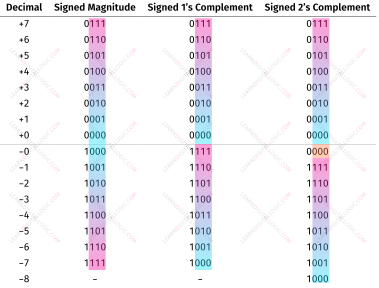
In a 4-bit signed magnitude representation, one bit is allocated for the sign, and the remaining three bits encode the magnitude. This allows representation of numbers from \(\mathsf{-7}\) to \(\mathsf{+7}\). The process is simple: convert the decimal number’s magnitude to its 3-bit binary equivalent and prefix it with a 0 (positive) or 1 (negative) sign bit. However, a notable drawback is that this method results in two representations for zero: \(\mathsf{+0 (0000) }\)and \(\mathsf{-0 (1000)}\). This dual representation can complicate arithmetic operations and coding, making signed magnitude less preferred in modern computing compared to other forms like 2’s complement.
Range of Numbers Stored in n-Bits
The range of numbers that can be represented in signed magnitude form with \(\mathsf{n}\) bits is determined by the \(\mathsf{n-1}\) bits available for the magnitude. The range spans from \(\mathsf{-(2^{n-1} – 1)}\) to \(\mathsf{+(2^{n-1} – 1)}\). For example:
- For \(\mathsf{4}\) bits (\(\mathsf{n=4}\)), the range is \(\mathsf{-7}\) to \(\mathsf{+7}\).
- For \(\mathsf{8}\) bits (\(\mathsf{n=8}\)), the range is \(\mathsf{-127}\) to \(\mathsf{+127}\).
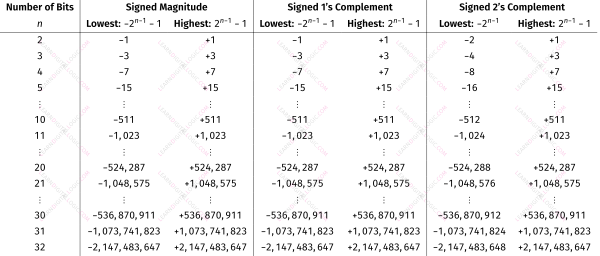
This range is identical to that of 1’s complement but differs from 2’s complement, which includes an additional negative number. A comparison of ranges across different signed number representations is available in the referenced figure.
Advantages and Limitations of Signed Magnitude Form
Advantages
- Intuitive Representation: The signed magnitude form is easy to understand, as it directly mirrors human conventions for positive and negative numbers.
- Simple Conversion: Converting decimal numbers to signed magnitude is straightforward, requiring only the binary magnitude and a sign bit.
Limitations
- Dual Zero Representation: Having both \(\mathsf{+0}\) and \(\mathsf{-0}\) can lead to inefficiencies and errors in arithmetic operations and programming.
- Complex Arithmetic: Addition and subtraction require additional logic to handle the sign bit, unlike the streamlined operations in 2’s complement.
- Limited Use in Modern Systems: Due to its inefficiencies, signed magnitude is rarely used in contemporary computing, where 2’s complement dominates.
Why Understand Signed Magnitude?
While signed magnitude is less common in modern digital systems, understanding it provides a foundational perspective on how signed numbers are handled in binary. It serves as a stepping stone to grasping more advanced representations like 1’s and 2’s complement, which are covered in detail on their respective pages:
- Signed 1’s Complement Form: Learn about the bitwise complement method for negative numbers.
- Signed 2’s Complement Form: Discover the standard for modern binary arithmetic.
- Addition and Subtraction in 2’s Complement: Understand how arithmetic operations are performed.
- Overflow in Signed Arithmetic: Explore overflow detection and prevention.
By mastering the signed magnitude form, you’ll gain insight into the evolution of binary number systems and their impact on computer arithmetic, enhancing your knowledge of computer science and digital electronics.